




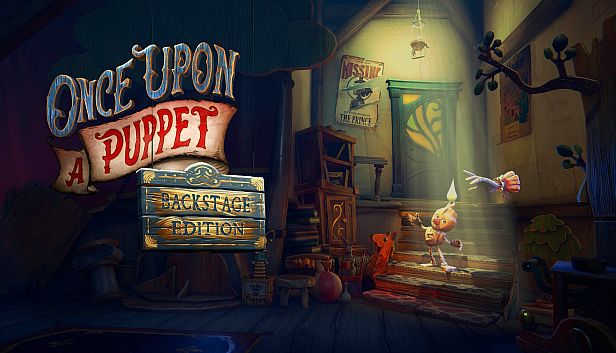




Once Upon A Puppet is a single-player 2.5D puzzle-platformer adventure game set in a theatrical world. Players take control of Nieve, a stagehand, and Drev, the puppet she manipulates through strings, as the pair navigate the Understage and work toward the Frontstage above.
Gameplay
The core loop centers on simultaneous control of both characters using separate analog sticks and triggers. Nieve handles movement and interactions on one side while directing Drev on the other, creating tension-based actions such as pulling levers, grabbing objects, and crossing gaps. Progression introduces new thread types that grant abilities including double jumps, hovering, and slingshot launches for Drev.
Environmental puzzles require arranging props, backdrops, and characters to rebuild stages and reveal story elements. Platforming sections involve jumping across moving platforms, avoiding hazards, and timing precise movements. Later chapters add chase sequences and stealth elements where players must evade threats that can end a run instantly.
The game unfolds across nine chapters that gradually layer mechanics. Early stages focus on basic grabbing and jumping, while later ones demand coordinated use of multiple abilities in more complex setups. Controls map actions to face and shoulder buttons, with a responsive but slightly floaty jump arc that suits the puppet-like movement theme.
Game Modes
The experience consists entirely of a linear single-player story campaign. There are no separate multiplayer options, competitive modes, or free-roam sections. All content ties directly into the narrative progression through the nine chapters, with puzzle-platforming challenges and set-piece sequences integrated into the main path.
Fractured stages appear as larger puzzle sequences within the campaign, tasking players with repositioning statues, adjusting lights, and manipulating scenery to complete theatrical reconstructions. These serve as extended challenges rather than standalone modes.
Story and World
The narrative follows Nieve and Drev as they confront fears and uncover secrets in a kingdom built around theater. Exiled to the ruined Understage, the pair retell forgotten stories while facing shadowy creatures that threaten to extinguish the lights. Dialogue from an ensemble cast of characters supports themes of friendship, self-discovery, and redemption.
Visuals emphasize stylized theater elements, with stages shifting between past and present. Cutscenes reinforce the puppet motif through detailed 2D sequences, and sound design highlights mechanical joint movements alongside the original score.
Is It Worth Playing?
The game delivers a focused, medium-length single-player adventure lasting roughly five to ten hours. Its puppeteering mechanic provides a distinctive twist on standard puzzle-platformer conventions, blending narrative and control in a way that rewards coordinated inputs. Player ratings on the PlayStation Store average near four stars from over one hundred reviews, while Steam user feedback sits in the very positive range.
Reception highlights the charm of the theater setting and steady introduction of new abilities, though some note the platforming and puzzles draw from familiar influences without major innovation. Controls can feel finicky in tight spots, and the overall package remains short with limited replay value beyond the main campaign.
It suits players who enjoy narrative-driven puzzle-platformers with a unique control scheme and are comfortable with a linear structure. Those seeking extended content or variety beyond story progression may find the scope limited, while fans of the genre will appreciate the consistent pacing and thematic cohesion.
