




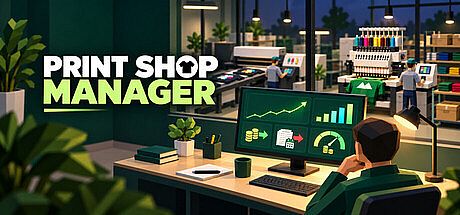


Print Shop Manager is a business management simulation game for PC that puts players in charge of a custom apparel and promotional products company. The experience centers on building a profitable operation from modest beginnings while handling the daily realities of quotes, production, staffing, and cash flow.
Gameplay
Players start with a small facility, basic equipment, a limited budget, and a small team. Customer requests arrive with details on products, quantities, deadlines, and budgets. Setting a selling price requires balancing the odds of winning the contract against production costs, material expenses, gross profit, payment terms, and available capacity. Some customers push back on price or request extended payment periods, forcing decisions on whether each job fits the current workload and risk tolerance.
Production spans multiple departments such as textile printing, embroidery, custom patches, direct-to-garment printing, and outsourced promotional items. Employees receive assigned hours across these areas, with priorities set for urgent or high-value orders. Choices about workflow speed affect output volume, quality levels, reputation, and team stress. Faster production draws volume customers while slower, careful pacing suits premium work.
Facility layout plays a direct role in efficiency. Machines, desks, storage, packing stations, and amenities must be positioned to avoid congestion and wasted movement. As the business grows, larger spaces become available for redesign. Finances demand constant attention because profit on paper does not guarantee available cash. Weekly payroll, rent, material purchases, marketing, loans, and accounts receivable all require tracking through detailed statements that reveal seasonal patterns and long-term trends.
Team management extends beyond simple hiring. Employees bring varied skills, salaries, personalities, and performance metrics including leads generated, closing rates, production output, attendance, and quality. Morale, stress, and trust respond to decisions on overtime, raises, promotions, and workload distribution. Poor choices can raise turnover while successful growth raises expectations from top performers.
Game Modes
Sandbox mode allows full customization of starting cash and reputation, giving players freedom to experiment with different strategies and growth speeds. Scenario mode presents specific challenges through pre-built situations that include rescuing an aging business, restructuring an overextended company, preserving a family shop's reputation, or rebuilding after a disaster. Each scenario supplies a distinct team, facility layout, financial position, and set of operational problems to solve.
Both modes support the same core systems but differ in initial constraints and objectives. Sandbox favors open-ended building and long-term planning, while scenarios test adaptability under pressure with fixed starting conditions. There is no single correct path; players can pursue high-volume output, premium quality focus, recurring B2B contracts, or a balanced operation designed for stability.
Key Mechanics and Challenges
Contract negotiation sits at the heart of every week. Players weigh the chance of winning work against costs, margins, capacity, and the risk of delays or complaints. Accepting a job with tight deadlines or 30-day terms can strain cash flow even when the numbers look favorable on paper.
Unexpected events test planning at any scale. Machine breakdowns, supplier delays, employee absences, production errors, late payments, and sudden opportunities all appear without warning. Responding effectively requires adjusting production schedules and cash reserves without losing control of ongoing orders.
Equipment decisions add another layer. Reliable local suppliers offer predictable delivery while imported machines cost less but carry longer and less certain lead times. Major investments in new departments or automation become available early, yet expanding too fast can expose the company to cash shortages or quality issues.
Is It Worth Playing?
Print Shop Manager appeals to players who enjoy detailed business simulations grounded in realistic constraints. The focus on cash flow, employee dynamics, layout efficiency, and contract risk creates a steady stream of meaningful decisions rather than simple number chasing. Those interested in the apparel and promotional products industry will recognize many authentic pressures drawn from actual shop operations.
The combination of sandbox freedom and structured scenarios provides replay value for different play styles. Players who prefer methodical planning and long-term growth will find satisfaction in optimizing workflows and team structures, while those who enjoy problem-solving under pressure can tackle the scenario challenges. The game rewards careful financial oversight and balanced risk-taking over rapid unchecked expansion.
Overall, it suits anyone seeking a thoughtful management experience that emphasizes operational realism and incremental progress over flashy mechanics or competitive multiplayer elements.