







Fear & Greed: Trading Empire is a strategy and simulation game that places players in charge of building a trading empire in a fictional cryptocurrency market. Every price movement stems from the actions of simulated participants rather than random generators, creating a living economy where individual decisions shape outcomes over time.
Gameplay
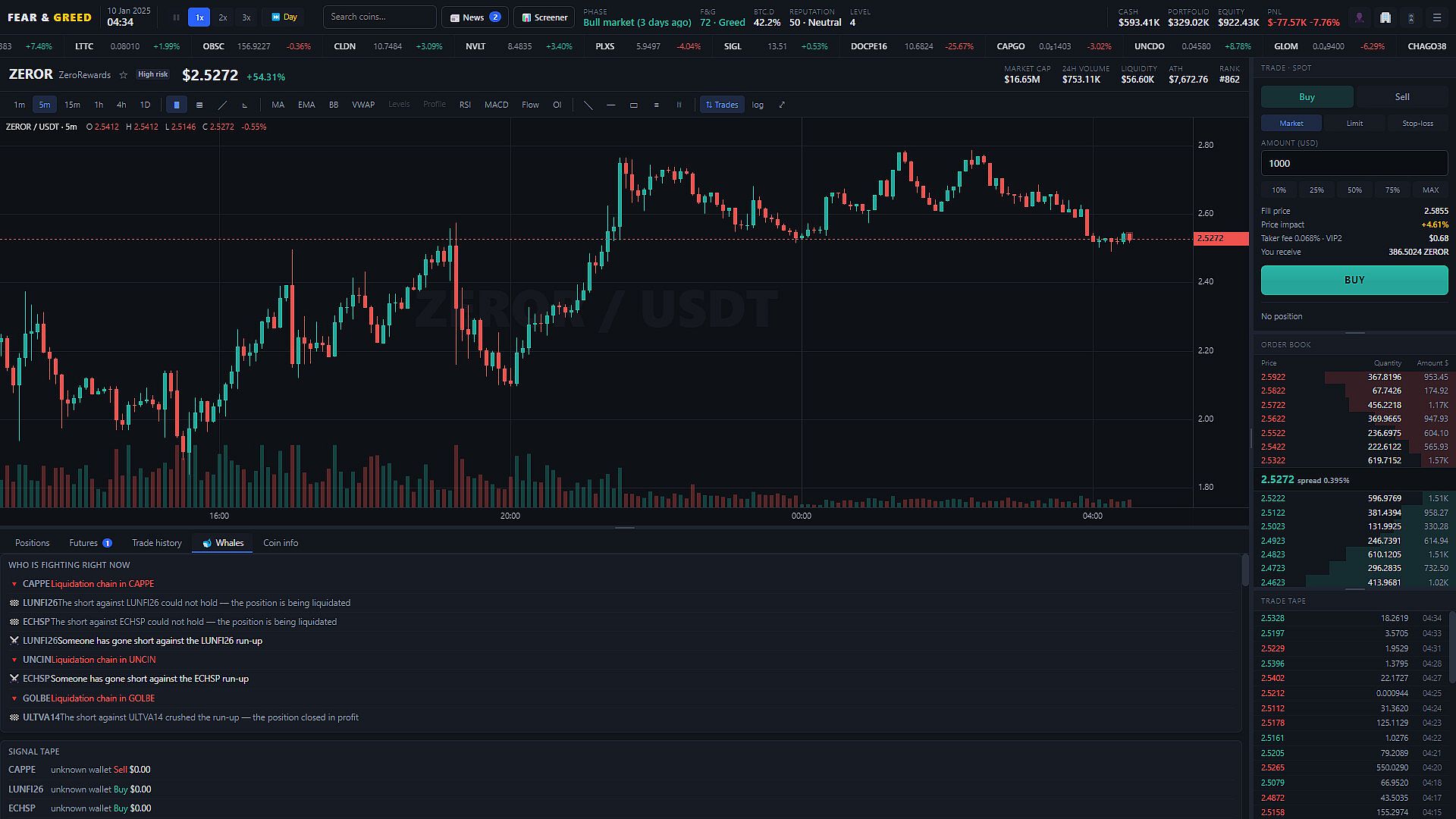
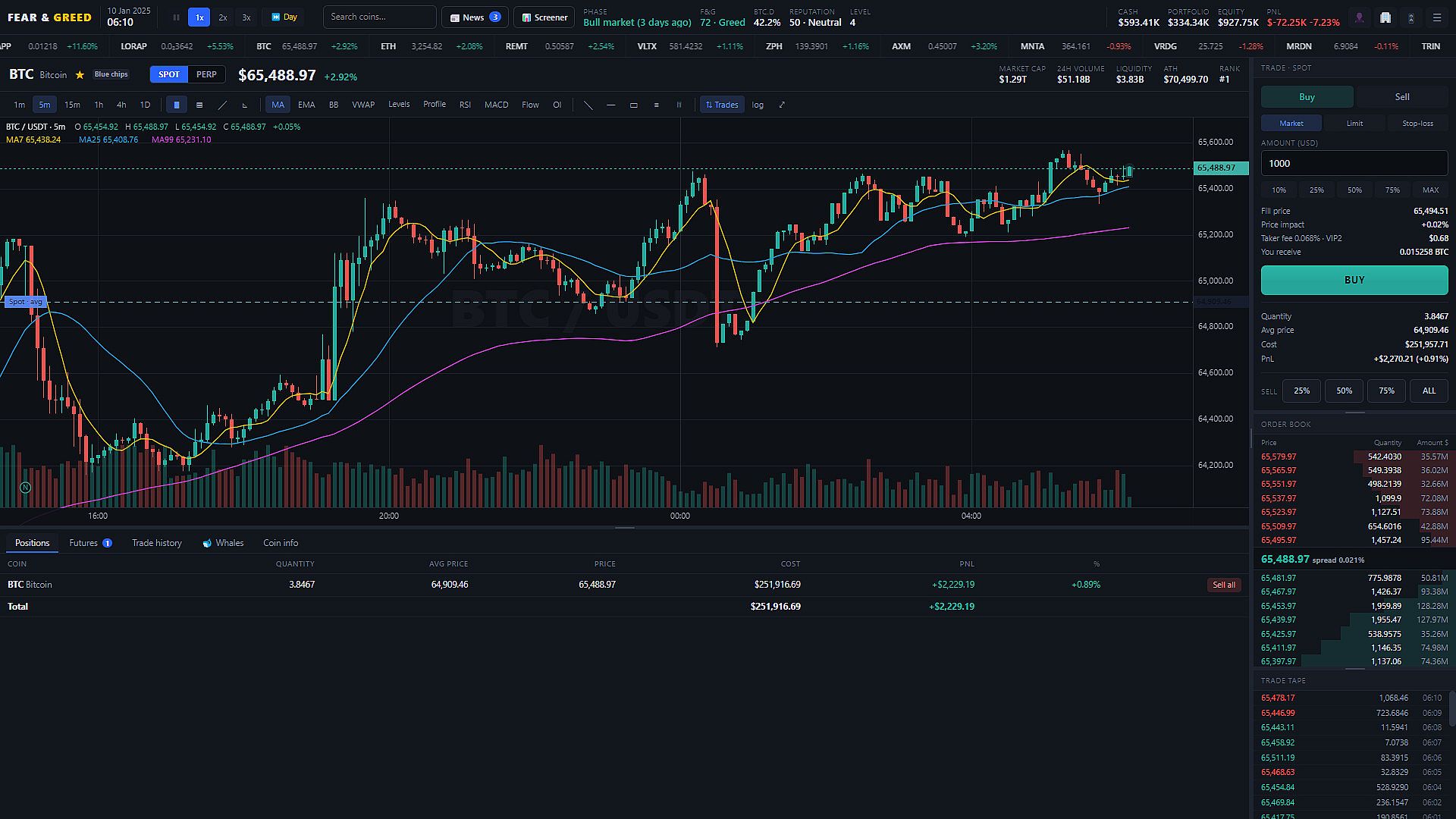
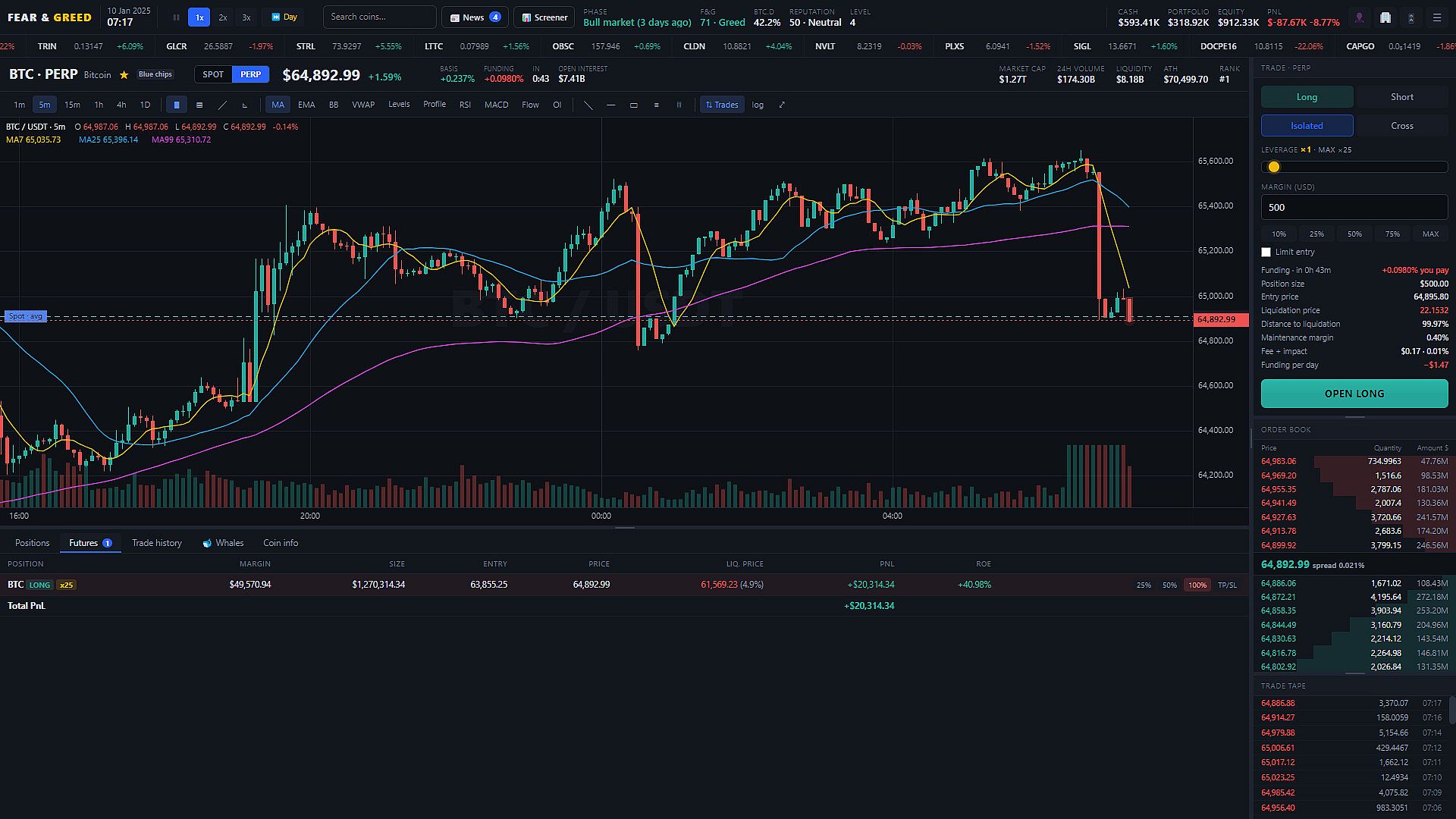
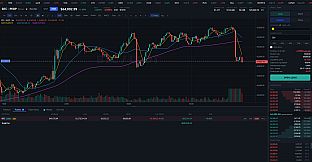
The core loop revolves around executing trades across 1,000 coins divided into 15 categories such as blue chips, memes, DeFi, GameFi, AI, Layer 2, new listings, and high-risk assets. A custom charting system supports candlesticks, Heikin Ashi, line, and area views on timeframes from one minute to one day, with up to 2.5 years of history available. Technical indicators include moving averages, exponential moving averages, Bollinger Bands, VWAP, RSI, MACD, and volume. Positions appear directly on charts alongside entry prices, live profit and loss, liquidation lines, limit orders, take-profits, and stops. Drawing tools cover trend lines, horizontal levels, rectangles, and Fibonacci retracements.
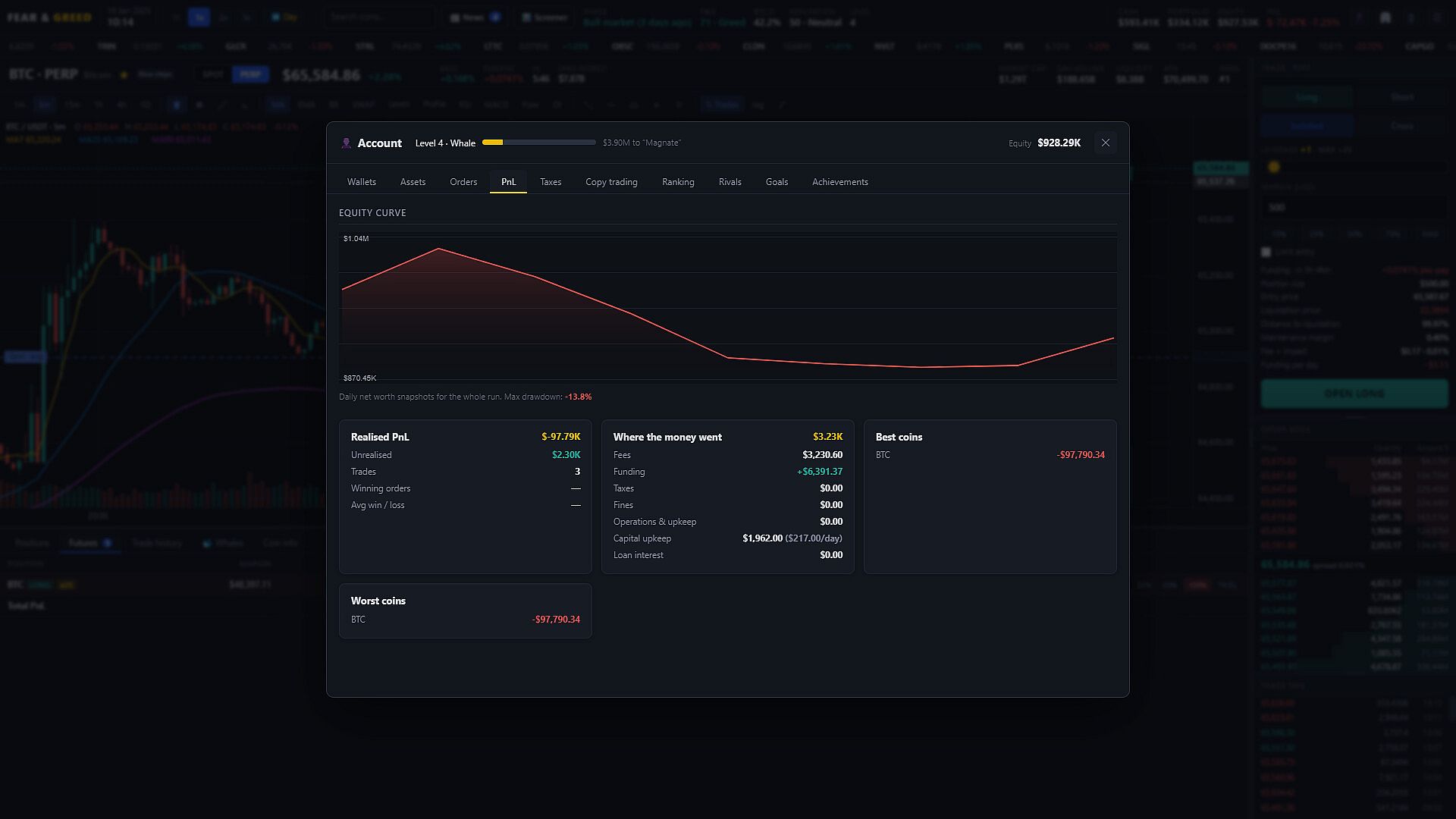
Order impact forms the central mechanic. Placing $3,000 into BTC shifts the price by 0.016 percent, while the same amount in a low-liquidity coin moves it by 6 percent. Impact fades with a two-hour half-life, and only 40 percent becomes permanent. Leverage reaches up to 125 times on major coins like BTC but drops to 2 times on micro caps and is unavailable on scam-tier assets. Liquidation triggers when losses consume 90 percent of margin. Funding rates settle three times per game day based on crowd positioning and can favor either longs or shorts.
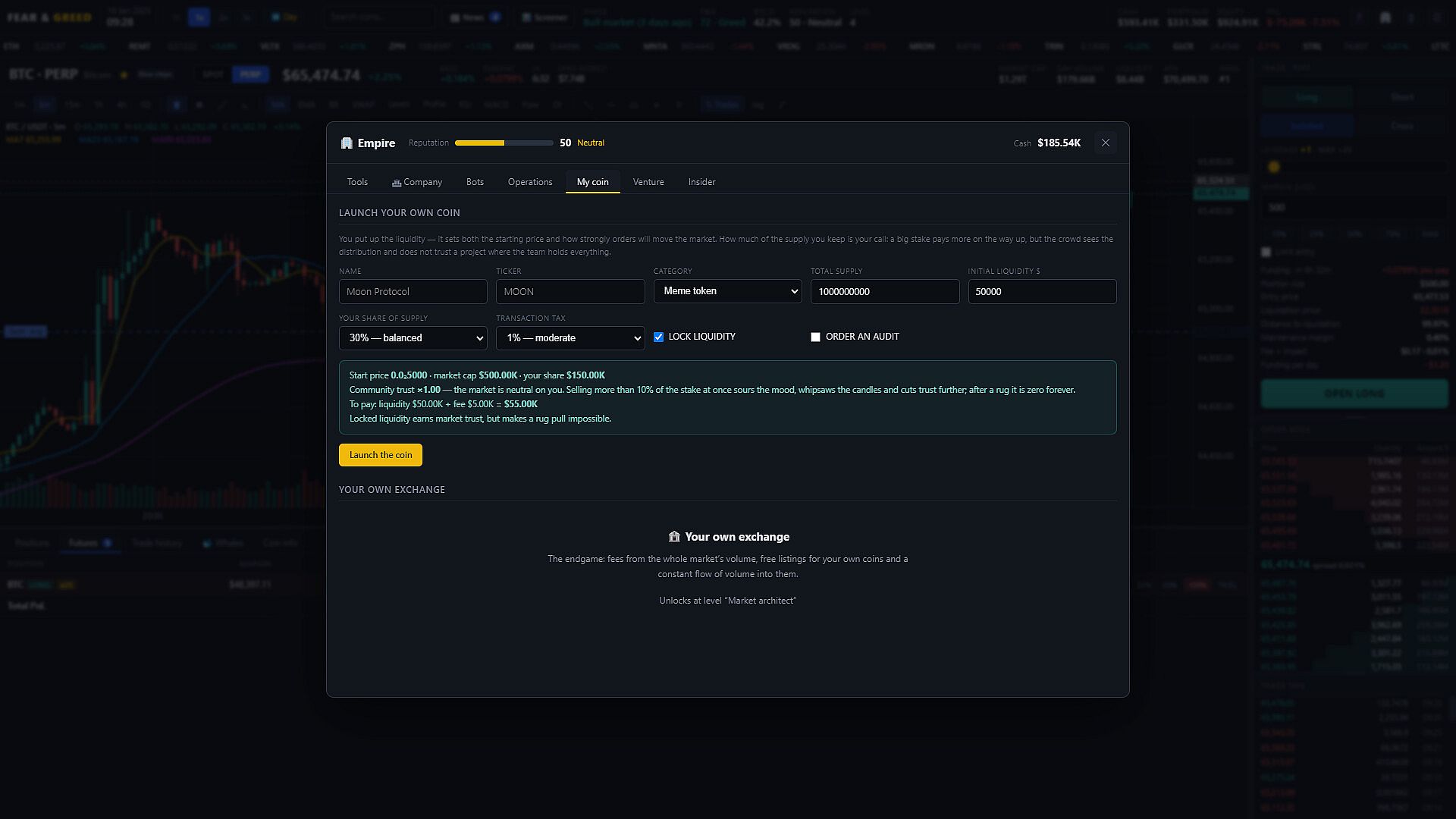
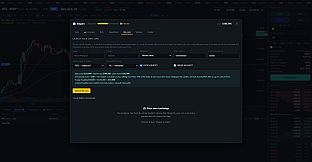
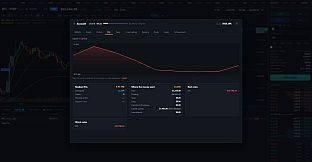
Reputation tracks from 0 to 100 and directly affects costs, with perfect standing granting 60 percent discounts and toxic levels imposing 140 percent premiums plus regulatory scrutiny. Trading bots handle grid, DCA, sniper, and arbitrage strategies. Insider contacts reveal upcoming news events hours in advance. PR campaigns and media holdings allow players to influence sentiment, though repeated efforts on the same coin lose effectiveness. Players can launch their own token with choices around liquidity locking that carry lasting reputation consequences. Copy trading lets subscribers follow top performers on a leaderboard of 40 simulated traders. Tax declarations occur every 90 game days, with underreporting risks leading to account freezes. Loans carry 25 percent interest over 180 days, and missing deadlines ends the run.
Game Modes
Hardcore mode activates by default, where bankruptcy erases all progress for that run. Procedural generation uses a seed to create unique coin parameters, liquidity levels, volatility, scam risks, cycle lengths between 70 and 115 game days, whale objectives, and starting market phases. Each restart produces a fresh market environment that prevents repetition of known patterns. A seven-phase cycle governs market behavior through accumulation, bull, euphoria, distribution, bear, capitulation, and depression stages. Scam coins can trigger instant rug pulls to negative 99.9 percent, while honeypots block sales and slow bleeds erode value gradually.
2,241 unique headlines drawn from 72 templates deliver news tailored to coin size, ranging from bridge hacks and delistings for micro caps to ETFs and halvings for major assets. A world wealth ranking follows a power-law distribution, positioning a starting $1,000 capital near the ten-millionth place out of a top near $1.5 trillion. Five languages localize the entire experience, including retroactive news translation. The simulation runs fully offline without accounts or servers.
Key Systems and Progression
Reputation serves as the backbone for long-term success, influencing fees, access, and external attention. Building an empire involves scaling from spot trades into futures, bots, media control, and personal token launches. Each action leaves traces that affect future opportunities, such as reputation penalties for dumping after self-promotion or stigma attached to unlocked liquidity on launched tokens. The live order book and trade feed display maker and taker fees with volume-based VIP discounts. Retail crowd behavior emerges organically, with overheating after sustained gains leading to natural pullbacks without scripted events.
Whales operate with distinct agendas, including accumulators buying during panic and pumpers executing multi-hour position builds followed by dumps. Swingers follow cycles while the broader retail base chases momentum. These layered participants create emergent price action that rewards observation and timing over pure speculation.
Is It Worth Playing?
Fear & Greed: Trading Empire suits players interested in deep trading simulations that emphasize market mechanics, order impact, and behavioral consequences rather than simplified interfaces. The single-player offline format supports extended sessions focused on strategy and empire building without external dependencies. Procedural variety across runs encourages multiple attempts, while hardcore bankruptcy adds stakes to decisions around leverage, reputation, and token launches. Those drawn to realistic simulation of liquidity effects, funding rates, and news-driven moves will find substantial systems to explore. Early Access status means the experience continues to develop, but the current feature set already delivers a cohesive trading sandbox grounded in verifiable mechanics from the source description.
