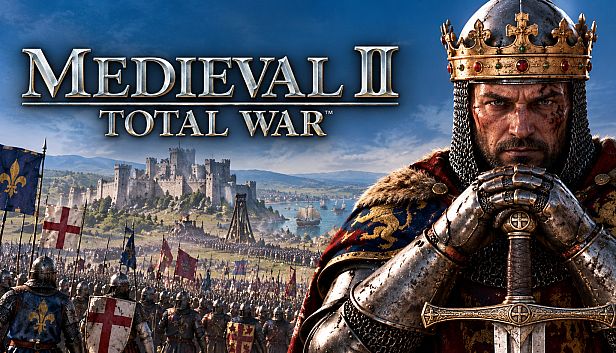


Total War: MEDIEVAL II is a strategy game that combines turn-based empire management with large-scale real-time battles set in the medieval period. Players take control of historical factions across Europe, the Middle East, North Africa, and eventually the Americas, aiming to expand territory through military conquest, economic development, and political maneuvering. The Definitive Edition bundles the base game with the Kingdoms expansion and all subsequent updates, delivering the full scope of content in one package for PC.
Gameplay
The core loop alternates between a strategic campaign layer and tactical battles. On the campaign map, players manage settlements divided into cities focused on economic growth and castles geared toward military recruitment. Resources fund building upgrades, army training, and agent deployment while diplomacy shapes alliances or rivalries. Religion plays a central role, with mechanics involving the Papacy, cardinals, inquisitions, and calls for crusades or jihads that can shift faction relations and public order.
Battles unfold in real time on detailed 3D fields where armies of several thousand troops clash. Command involves positioning infantry, cavalry, and missile units while accounting for terrain elevation, weather effects, and unit morale that influences routing or holding the line. Gunpowder units appear in later eras, altering siege tactics and open-field engagements. Armies move and tire based on realistic factors, and finishing moves add visual impact to close combat.
Game Modes
The primary single-player experience centers on the grand campaign, available in shorter or longer variants with specific victory conditions tied to territorial control and key cities. Custom battles allow free setup of engagements, while historical battles recreate notable conflicts from the era. Multiplayer supports direct battles for up to eight participants.
The Kingdoms expansion adds four dedicated campaigns on expanded regional maps. Britannia focuses on the British Isles with factions including England, Scotland, and Wales. The Teutonic campaign covers Northern Europe and Baltic conflicts involving the Teutonic Order, Lithuania, and others. The Crusades campaign centers on the Holy Land with participants such as the Kingdom of Jerusalem, Egypt, and the Byzantine Empire. The New World campaign opens North and South America for conquest, introducing playable factions like the Aztecs, Mayans, and Apachean Tribes alongside European arrivals.
Hotseat play enables multiple participants to alternate turns on the same computer for campaign progression, supporting both competitive and cooperative formats across the grand campaign and Kingdoms content.
Campaigns and Factions
Thirteen additional factions join the original roster through Kingdoms, each with distinct unit rosters exceeding one hundred new types and fifty new building options. These additions expand strategic variety, from light cavalry specialists in certain regions to unique New World infantry and missile troops. Over sixty new territories appear across the four campaign maps, supporting extended play sessions that can span dozens of hours per campaign.
Is It Worth Playing?
This title suits players who enjoy blending grand strategy decisions with hands-on tactical command in historical settings. The combination of deep settlement management, religious and diplomatic systems, and visceral battles creates substantial replay value, especially when exploring different factions or the regional Kingdoms campaigns. It continues to receive overwhelmingly positive feedback from a large player base years after release, with consistent activity indicating ongoing interest. Those drawn to turn-based empire building paired with real-time combat will find a complete package here, while anyone seeking purely modern visuals or simplified interfaces may prefer newer entries in the series. The Definitive Edition ensures access to every campaign and feature without additional purchases.